Friday, March 22, 2013

Will the Real Doc Holliday Plot Show Itself?


I had time enough in the afternoon to check out Glenwood Springs, Colorado. It was only twenty miles away from where we were camped. I had read somewhere that Doc Holliday, the famous itinerant, drunken dentist, lies a-molding in the Lynwood Cemetery. I stopped and asked two smiling, jovial, good old boys who were drinking beer on the front steps of a gas station where I might find the cemetery where Doc Holliday was planted. Their directions lead me a couple miles out of town and to the Rosebud Cemetery, definitely the wrong place. On the way back, I stopped and asked a man who was watering in his front yard. He gave me great direction; he knew right where to go. I followed them to the tee and the street I finally turned up was at the very same corner where the two smiling, jovial, good old boys gave me their fine directions. Now, you don't suppose those two guys were having fun with me? Nah.             
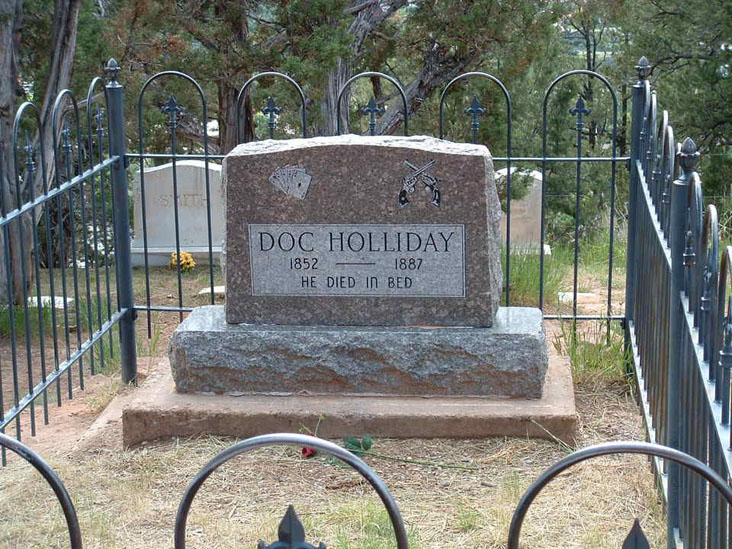
    Anyway, I got to the cemetery trailhead and parked the car. This was the right place. A sign pointed the way to the cemetery, up a steep trail. I found out later, no one knows exactly where Doc Holliday is buried. It's an unmarked grave somewhere in the cemetery. A sign explained with words to this effect: John Holliday arrived in Glenwood Springs in last stages of the disease know then as consumption. He worked in the gambling houses. People liked him. When he died, they passed the hat and collected enough money to bury him. A Midwestern gang threatened to steal the body, so Doc's employers hid him away for several years in the basement of a local house. When they felt it was safe, they buried him in an unmarked grave. I guess they wanted to make sure he stayed put. Years later, when he had become bigger than life because of his dealings with the Earps and the OK Corral shootout, a nice monument was carved and placed in the cemetery. It reads, "Doc Holliday, 1852 – 1887. He died in bed." A smaller headstone explains that this is not the actual burial site.
            Wait a minute, I’ve seen the movies. The first one was My Darling Clementine, starring Henry Fonda as Wyatt and Victor Mature as Holliday. In the big shoot out Doc is firing away from behind a rail fence when he gets shot and dies right in the middle of a coughing spell ...The End.  But in Tombstone, Doc dies moments after a poignant, deathbed visit from Wyatt Earp. The camera moves in for a close up. Holliday is weak. His eyes blood shot. There are beads of sweat on his brow and he is unable to feel his toes. He smiles and whispers his last words, “Well, I’ll be damned.” ... The End. 

Of course My Darling Clementine, got it all wrong, what do you expect it’s a movie. At least Tombstone is accurate in one respect, Doc Holliday, as the cemetery epitaph says, died in bed.

Q

Thursday, February 14, 2013

George Washington Gale Ferris, Jr.


This is the 154th anniversary of the invention of the Ferris Wheel, which became a major attraction at the Chicago World Columbian Exposition of 1893.
    The man who invented it grew up in Carson City. Ferris arrived in Nevada in 1864 at the age of five. His father, George Ferris Sr., was a horticulturalist who was responsible for much of the landscaping in Carson City in the 1870s, including the grounds of the State Capitol.
    The Ferris family lived in the Carson Valley for two years and then moved to a house on the southeast corner of Third and Division streets in Carson City. In 1875, George Ferris Jr. left Nevada to attend the California Military Academy in Oakland. In 1880, he received a degree in civil engineering and was hired by an architectural firm in New York City.
    After a few years, a Pittsburgh firm hired him and it was while working there that he designed the Ferris Wheel. It grew out of the desire to have some kind of structure that would be just as iconic as the Eiffel Tower. Apparently the erecting of the tower was somewhat of a thorn in the side of American engineers. The Americans wanted something grander, something that would say to the world that American engineering prowess was just as good as the French’s, maybe even better.
    The first impression of the fair’s steering committee was not favorable. They initially dismissed the design as being a “crackpot” idea. It was, “modeled on a bicycle wheel: in the pace of spokes to maintain the wheel’s shape and balance, it had heavy steel beams, the ‘forks’ in which the axle was set were two steel girder pyramids. The wheel was 264 feet high, the supporting towers were 140 feet high, and the axle – the largest piece of steel ever forged in the US – weighed 46 ½ tons. The wheel carried 36 elegantly outfitted passenger cars, each of which could fit 40 people sitting or 60 people standing. That's a maximum capacity of 2,160 people! The wheel was spun by either of two 1,000 horsepower steam engines, and stopped by an oversized air brake.”
Much to the committee’s surprise the wheel was proved to be safe.
     It was an immediate hit at the fair and in less than a half year it had carried 1.4 million passengers. In 1904, the wheel was moved to St. Louis for the Louisiana Purchase Exposition. Following the show, it was destroyed for scrap. However, the wheel outlived Ferris, who died in Pittsburgh in 1896 at the age of 37.

Q

Friday, January 18, 2013

Westward Ho!


It was bound to happen...In the late 18th century, this young nation wasn’t content to be confined to the boundaries of the original thirteen colonies, so some eighty years after the Pilgrims landed, exploration shifted into high gear and thus began what was termed “manifest destiny,” the expansion across the continent. Several trails were blazed. People packed up their belongings and headed west. The historic trails reached their peak between 1830 and 1870. During that time period upwards of two-thirds of a million pioneers and traders used them. It took the pioneers six months to do what we can do in a few days. And we do it free of all the hardships and in relative comfort. We have no rivers to ford, no Indians to fight, no disease to contend with, and no shortage of food and water to suffer through. Best of all, we don't have to walk most of the way.
   In addition to the pioneer trails, I’ve added four other trails: the two that were developed so that goods could be brought for trade to new settlements in the southwest, the route used by the Pony Express and finally the all important first transcontinental railroad route.

Lewis and Clark Trail 
”The Lewis and Clark Expedition of 1803-1806 was perhaps the most important in the history of American exploration. It opened up vast new territories to American knowledge. After the Louisiana Purchase, Meriwether Lewis and William Clark were sent to explore the new American territory. They sought a land route to the Pacific, and along the way they made many scientific observations, collected many specimens of flora, and studied the Indians.” 
The Oregon Trail  The first serious attempt by a group to emigrate west along the Oregon Trail took place in 1841. The trail ran from the Missouri River in Kansas City, across Nebraska and Wyoming, on to southern Idaho, and finally into Oregon. Here we have a bit of a puzzle. The map I looked at had it ending in Vancouver, but I have seen a sign in Seaside, OR on the coast west of Portland, which says that that was the end of the trail.  Finally according to Wikipedia the terminus is Oregon City. When asked the question, Where does the Oregon Trail begin and end? WikiAnswers had this to say:
    Well, that depends on how you look at it. Officially, according to an act of Congress, it begins in Independence, Missouri, and ends in Oregon City, Oregon. To the settlers, though, the trail to the Oregon Country was a five-month trip from their old home in the East to their new home in the West. It was different for every family. Some people got ready to leave the East, or "jump off" as they called it, in towns like St. Joseph or Council Bluffs, and others jumped off from their old homes in Illinois or Missouri and picked up the Oregon Trail in the countryside. Along the way, they could choose to take shortcuts or stick to the main trunk of the Trail, and the end of their journey didn't really come until they settled a claim somewhere in the vast Oregon Country.

The Mormon Trail  The trail began in Nauvoo, IL, the year was 1846. Harassment, antagonism, and persecution forced the Mormons out of Nauvoo. The trail’s route ran 256 miles across Iowa to the Missouri River and then 1032 miles across the Great Plains following pretty much the same path as the Oregon Trail until eastern Wyoming where the trail headed southwest to the Valley of the Great Salt Lake. Over a twenty year period, 70,000 Mormons traveled by wagons and handcarts along this route. 


The California Trail  The trail followed, generally speaking, the same course as the Oregon and Mormon Trails. Near American Falls, Idaho, it headed south across Nevada, over the Sierras and into the golden state.


The Santa Fe Trail   William Becknell was a trader who wanted to take his goods to Santa Fe to sell. He felt the new settlers in New Mexico, who were lacking essentials, would welcome his business, which turned out to be true.


The Old Spanish Trail  The trail was used as a trade route linking Santa Fe, New Mexico and Los Angeles. It had a brief, but active heyday between 1830 and 1848. Traders took goods west and returned with mules and horses.


The Pony Express  The Pony Express was a brave enterprise. It took a lot of guts for the young riders to brave the environment, the Indians, and the weather. It was a job filled with danger. An advertisement recruiting riders asked that recruits be expert riders, willing to risk their lives. "Salary, $25 a month and Orphans Preferred," read the handbills. From St. Joe to Sacramento in ten days was the promise, and they did it. Remarkable! It only lasted 18 months (April 1860 to October 1861) because by that time transcontinental telegraph lines stretched across the continent, and as a result the Pony Express was forced out of business.

Transcontinental Railroad  By 1869 the transcontinental railroad was completed, Leland Stanford pounded in the golden spike (supposedly) and travel over the various pioneer trails declined. I’ve read that old man Stanford tried three times to hit the spike and missed all three times. Finally a railroad employee did the deed and history was made at Promintory Point, north of Salt Lake City.


Saturday, December 15, 2012

Waterhole Ike, tale of a beer guzzler


Once upon a time there was a famous resident 
of Golconda, Nevada.  His name was “Waterhole Ike.”  He lived there in the 1970s.  Mark Cowley ran the local saloon called Waterhole  #1.  There was one customer who was regular as clockwork.  Every morning about 10:30 here he’d come for his bucket of beer.  There was one thing about the customer that was mighty peculiar; he was Cowley’s pig, named appropriately “Waterhole Ike.”  Cowley learned that big money could be made putting famous animals out to stud.  So he decided to form a syndicate, sell stocks and then watch the money roll in.  He read that the very same thing had been done when the champion racehorse, Secretariat, was sold to a syndicate.  Cowley began selling shares and soon the money was mounting up, so much so that Cowley figured he needed to open a bank account in Ike’s name.  The local bankers refused, because Waterhole Ike didn’t have a social security card.  Cowley got an application, gave Ike a last name, a father and mother, and a birth date (5/1/1974).  Cowley submitted the application, having signed for Ike and in no time at all Waterhole Ike had himself a Social Security number (530-80-4623) and later a proper bank account, so Cowley could deposit money for Ike’s retirement.  The $25 stud fees soon began rolling in.  The press got hold of this and soon Ike was in the national press.  Over several years Ike fell on hard times and his bank account started to shrink.  About that time Ike fathered nine little piglets.  Crowley went to the welfare office in Winnemucca.  He told them his friend with a proper social security card was out of work with nine children to support and long story short, Ike began receiving $600 a month and food stamps.  But Cowley never cashed the checks or used the stamps.   Cowley grew tired of the saloon business, so he sold it and moved away.  And what became of Waterhole Ike, a Golconda legend, he lived to a ripe old age, as far as pig life goes.  The End.

This is mostly fact believe it or not.  Sorry about the poor quality picture of Ike.  It’s the only one I could find.

Saturday, November 17, 2012

Henry P. T. Comstock and His Big Mistake


Two Irish gold miners, Pat McLaughlin and Peter O’Reilly, were digging around a small spring up on Mount Davidson, near what would soon become Virginia City.  The year was 1859.  They found gold, but the two miners were annoyed by a bluish mud that fouled their sluice boxes and caked itself on picks and shovels.  When that mud was carried to an assayer in Placerville, it was found to be almost pure sulphuret of silver. 
    Not long after the discovery, Henry P.T. “ol’ Pancake” Comstock just happened to be passing by.  He had earned the nickname because people claimed he was too lazy to bake bread, making easy flapjacks instead.  He was born in Ontario, Canada in 1820 and as an adult drifted around a lot working in the United States and Mexico as a gold prospector, a trapper and a shepherd.  He arrived in the Nevada Territory just ahead of the greatest mining discovery ever made.  Comstock had earned the reputation as a braggart and somewhat of a charlatan.  Apparently Comstock had a keen understanding of ore.  The moment he accidently came upon the two miners and saw what they were doing he immediately announced that he owned the property. The gullible miners took him at his word and agreed to make Comstock a partner, which Comstock quickly accepted.  Because of his assertion, he insisted that the claim be named for him, so it became known, of course, as “The Comstock Lode” and went on to be the richest gold and silver strike in history.
    Gold and silver in Nevada also caught the attention of Abraham Lincoln, who needed additional capital in order to keep the Union solvent during the Civil War, so in 1864 Lincoln made Nevada a state even though officially it didn’t contain enough people to constitutionally become a state.  From this the state earned the nickname, “Battle Born State.”
    Comstock, a man who often made rash decisions, sold his interest prematurely for only a few thousand dollars.  He then purchased stores in Silver City and Carson City and bought a Mormon wife, who very soon upped and ran away.  Comstock’s businesses failed and he wandered off to Montana and wound up in Bozeman.  He died there in 1870 alone, having accomplished very little in his life. 
    It has been claimed that his turn of fortune and the missed opportunity with the Comstock Lode unhinged his mind.  It’s not clear exactly how he died.  One account says he was shot, either as a result of a robbery or as payback.  Another account claims he went insane because of his misfortune and committed suicide.  He had no family and so there was nowhere to send his remains.  He was buried in Bozeman. 
    But Henry P.T. “ol’ Pancake” Comstock lives on as one of Nevada’s colorful folk characters.

Q

Tuesday, October 2, 2012

O.D. Gass & the start of Las Vegas


While reading an article titled, The First 100 Persons Who Shaped Southern Nevada one name stood out from the others, not because of the person’s fame, but because I just liked his name...Octavious Decature Gass.
    He was born in 1829 in Richland County, Ohio of Scottish-Irish descent.  At 18 Gass began searching for a way to make a fortune.  Unfortunately his timing wasn't very good.  He’d arrived at the right places where either gold or silver deposits had been discovered, but always a little too late.  Since his mining claims never paid off, he decided to look elsewhere.  A friend asked him to be a partner in a store and ranch, which happened to be halfway between Salt Lake City and Los Angeles on the Mormon Trail in a valley that travelers in 1829 had named Las Vegas, which is Spanish for the meadows.  The valley was green and lush because of the many artesian wells. 
    In 1855 Mormons had built a fort and established a post office, which they named Bringhurst, in honor of the Mormon missionary who was directed by Brigham Young to establish a colony in the valley.  Two years later the site was abandoned because of political disagreements between the colony’s leadership.  Gass occupied the fort, renamed the site Los Vegas Rancho and built a ranch house using part of the fort's foundation and a wall.  He changed the spelling on purpose so as not to be confused with Las Vegas, New Mexico, a Mormon settlement 500 miles to the east.  The year was 1865.  
    Gass’s search for his fortune didn’t come from the pick and shovel work of mining; it came from selling to travelers and boomers (people who live in a boomtown) their daily necessities.  He and his partners restored and made many improvements to the old fort, hiring friendly Paiutes as laborers and soon it was a thriving way station.  Eventually Gass bought out his partners, which gave him sole ownership of 640 acres, to which he eventually added more acreage.  The ranch prospered, because it had sufficient water to support enough livestock, fruit trees and vegetable crops.  It kept O.D. in business for nearly twenty years.
    By the time Gass was 50 years old, he had all the appearance of a successful man.  He had expanded the ranch to 960 acres and had employed 30 men, which included a veterinarian, blacksmith, barn keeper, several Indian women to handle laundry and a cook.  O.D. was the Justice of the Peace of Lincoln County and had married the niece of U.S. Grant.  But he was also very much in debt, so he tried to sell the ranch.  At about that time  what was to be a bumper crop failed.  Gass had hoped it would bring in enough money to pay off his debts.  That was the last straw, so in 1881 he pulled up stacks and with his wife and children and 1,500 head of cattle abandoned the rancho and headed for California and oblivion.
    It would have been impossible in the late 1800s for O.D. Gass to imagine that his Los Vegas Rancho would eventually become a mega tourist attraction with high-rise hotels and all that glitz.  Ironically the man and the ranch are long forgotten, but there is a street downtown that bears his name.  And what would Gass say about not being well remembered?  I really don’t think he’d mind, because according to the article I read, apparently he didn’t care much for Nevada, anyway.

Friday, September 7, 2012

Shorty Harris, man of the desert


If you travel to the ghost town of Rhyolite, just outside of Beatty, Nevada, you’ll find this whimsical sculpture of a miner and his able bodied companion, a penguin.  What a hard rock miner would be doing with a penguin is beyond me, but then again nothing in the Goldwell Open Air Museum is a true reflection of reality (see my blog entry of May 2011).  The sculpture is a tribute to a local legendary character of the early days in Nevada, one Shorty Harris.  Shorty’s life mirrored the many mining towns that became Nevada ghost towns...rags to riches and back to rags.  (Side note: the artist, Fred Bervoets, said the penguin represented himself.  A penguin would be out of place in the desert and that’s just how Bervoets felt.)
    Frank “Shorty” Harris was born in Rhode Island in 1856.  He became an orphan at the tender age of seven and by age fourteen traveled from mining town to mining town, from Colorado to Arizona to Idaho.  Eventually he made his way to Death Valley and it must have agreed with him because he stayed in the area for the rest of his life.
    He stood 5’ 4”, had big ears, blue eyes and a bushy mustache.  Shorty was a teller of tall tells and a friend to anyone who was down on his luck.  In fact he was generous to a fault.
    Evidently Shorty could “smell” gold.  He made several discoveries, many worth a great deal of money, but Shorty rarely profited from them.  He was more interested in the searching than he was in amassing fortunes.  Then there was the fact that he like drinking and didn’t like the hard work of mining, so ultimately with each find he would sell it off for a pittance of its true value.
    His biggest discovery came as a lucky hapintance.  One morning he was camped with his partner, Ernest “Ed” Cross.  While Cross was fixing breakfast, Shorty was out chasing after his mule that had run off during the night.  Shorty tripped over a rock and as he stood up and brushed himself off he was amazed by the rest of rocks in the area.  He immediately yelled for Ed and they scooped up a bunch of the rocks and headed for Goldfield and an assayer.  The rocks where rich in gold and that was the beginning of the fabulous Bullfrog Claim.  Shorty named it that because of the color of the rocks.  To celebrate he went on a bender that lasted for days.  When he finally sobered up he learned he had lost or sold his interest in the discovery.
    Undaunted Shorty continued to wander the desert.  In 1904 he managed to get a grubstake and with a new partner headed for the Panamint Mountains where they found rich gold pockets.  And once again Shorty got drunk and spent much of time completely out of it while others were profiting.  As usual he came up penniless.
    A year later once again he convinced backers to grubstake him.  Now his partner was Jean Pierre “Pete” Aguereberry.  It was Aguereberry who made the discovery and this time Shorty’s backers kept Shorty from getting drunk and rushed him to San Francisco to find investors.  Finally Shorty came out of a discovery with money in his pocket: 50,000 shares in the Cashier Gold Mining Company and $10,000 in cash.  The town that sprung up around the claim was named Harrisberry and then a couple years later it was changed to Harrisburg.  Today there is very little left.
    Shorty Harris lived a long adventurous life.  He continued to prospect, but never really owning a mine of his own.  He simply loved the looking more than the having.  He died in 1934 in his cabin in Big Pine, California.  Shorty was laid to rest just as he requested, beside his old friend, Jim Dayton in the valley both of them loved, Death Valley.  The site is at base of the Panamint Range on the West Side Road.  He wrote his own epitaph.  He wanted it to read, “Here lies Shorty Harris, a single blanket jackass prospector.”